Birmingham was founded in 1871 and incorporated Dec. 19, 1871. Its 160 National Register listings run from Arlington to Sloss Furnaces. Museums and hours.
Last checked Oct. 17, 2026. Founding facts come from the City of Birmingham’s About Birmingham page; listings and years from the National Park Service’s National Register data, updated through May 22, 2026; hours from each site’s own page.
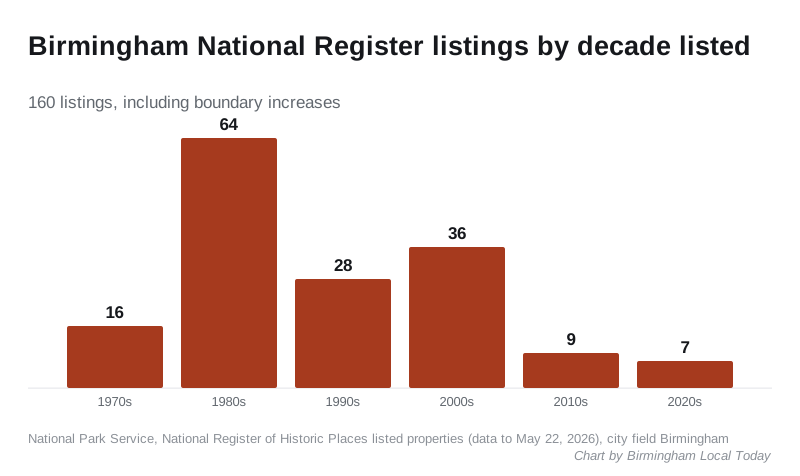
Birmingham was founded in 1871 at the crossing of two rail lines near one of the world’s richest deposits of minerals, and the Alabama Legislature passed an act to incorporate the city on Dec. 19, 1871, according to the city’s About Birmingham page. Iron ore, coal and limestone defined the city at its founding, the city says, and its industrial and civil rights history is written across 160 National Register listings.
Visit
- Sloss Furnaces National Historic Landmark: 1st Avenue North at 32nd Street; free admission (city page)
- Arlington Historic House: 331 Cotton Ave. SW, Birmingham, AL 35211; Tuesday to Saturday, 10 a.m. to 3 p.m.
- Vulcan Park and Museum: 1701 Valley View Drive, 205-933-1409
- Negro Southern League Museum: free for most visitors; group visits, 205-581-3040
- Birmingham Civil Rights National Monument: National Park Service
How the city began
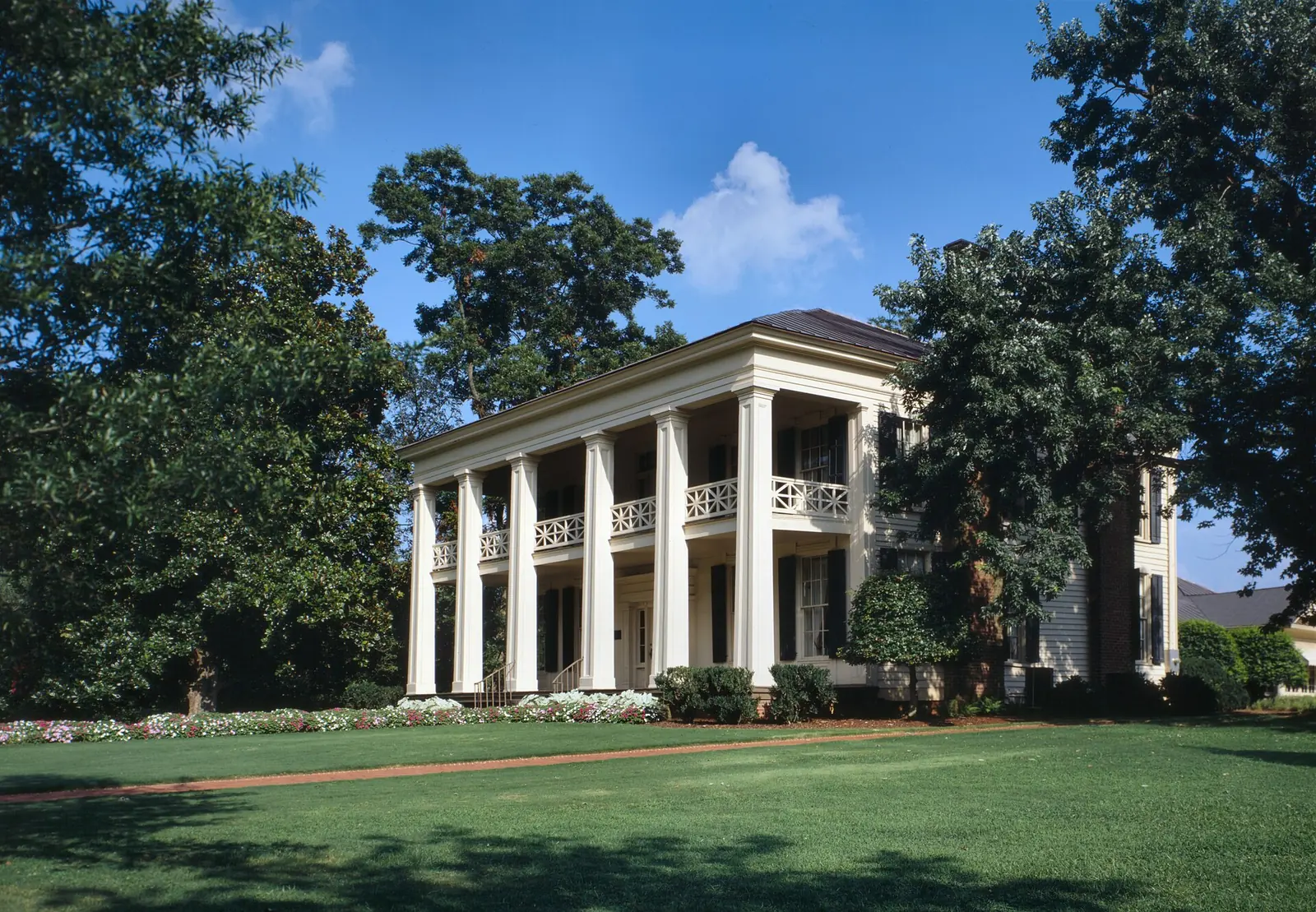
The city’s own history is short and specific: founded in 1871 where two railroads crossed beside iron ore, coal and limestone, and incorporated by the state that December. One of the region’s earliest landmarks predates the city: Arlington, in the Elyton community, began as a small structure built in 1822 and was expanded to its current appearance in 1842, the city says. It was the first Birmingham property listed on the National Register, in 1970.
The National Historic Landmarks
Two Birmingham sites carry the federal government’s highest historic designation, according to the National Park Service data:
- Sloss Blast Furnace Site, listed on the National Register in 1972 and designated a National Historic Landmark in 1981. The city says Sloss operated for 90 years until the iron stopped pouring in 1971, and was saved by residents and a city investment.
- Sixteenth Street Baptist Church, listed in 1980 and designated in 2006.
Historic districts downtown and beyond
The Downtown Birmingham Historic District was listed in 1982 and enlarged in 1985, 1998 and 2016. Other listed districts include the Morris Avenue Historic District (1973), the Heaviest Corner on Earth at 1st Avenue North and 20th Street (1985), the Birmingham Civil Rights Historic District (2006), Five Points South (1983, enlarged three times) and neighborhood districts from Norwood and Woodlawn to Ensley and Avondale Park.
Museums and sites open to visitors
Sloss Furnaces. Admission is free, with a self-guided tour of the 15-acre site. Guided tours cost a small fee and run Tuesday to Saturday at 10:30 a.m. or 2 p.m.; the city asks visitors to call at least a day ahead (Discover Sloss). The city’s calendar shows Sloss closed on Veterans Day, Thanksgiving and Christmas.
Arlington Historic House and Gardens, 331 Cotton Ave. SW. Open Tuesday through Saturday, 10 a.m. to 3 p.m.; the last tour ticket is sold at 2:30 p.m. Closed Sunday, Monday and city holidays (visit page).
Vulcan Park and Museum, 1701 Valley View Drive. The Vulcan statue was listed on the National Register in 1976. The park grounds, observation tower and museum are open 10 a.m. to 8 p.m. Sunday through Thursday and 10 a.m. to 9 p.m. Friday and Saturday, according to Vulcan.
A.G. Gaston Motel, part of the Birmingham Civil Rights National Monument. Built in 1954 by entrepreneur A.G. Gaston to give Black travelers first-class lodging, it is open Thursday to Saturday, 10 a.m. to 4 p.m., the city says (monument page).
Negro Southern League Museum. Admission is free for most visitors; the museum asks a $1 donation per person for groups of 10 or more, scheduled in advance at 205-581-3040 (visit page). Nearby Rickwood Field, listed in 1993, is the oldest professional ballpark in the United States, the city says.
Oak Hill Cemetery, 1120 19th St. N., was listed on the National Register in 1977.
Every National Register listing
These are all 160 entries the National Park Service lists under Birmingham, with the year each was listed. A few listed under a Birmingham address sit just outside the city limits. Boundary increases are separate entries.
| Listing | Year listed |
|---|---|
| Age-Herald Building | 1984 |
| Agee House | 1986 |
| Alabama Penny Savings Bank | 1980 |
| Alabama Theatre | 1979 |
| American Laundry Company Building | 2024 |
| Anderson Place Historic District | 1986 |
| Anderson Place Historic District (Boundary Increase) | 1991 |
| Arlington | 1970 |
| Arlington Park | 1995 |
| Automotive Historic District | 1991 |
| Avalon | 1985 |
| Avondale Park Historic District | 1998 |
| Bank of Ensley | 1984 |
| Belcher-Nixon Building | 2009 |
| Belview Heights Historic District | 2000 |
| Birmingham Civil Rights Historic District | 2006 |
| Birmingham Wholesale & Retail (West) Historic District | 2024 |
| Birmingham Wholesale Warehouse Loop West Historic District | 2015 |
| Birmingham, Railway, Light and Power Building | 1980 |
| Birmingham-Southern College | 1999 |
| Blessed Sacrament Academy | 1980 |
| Blessed Sacrament Catholic Church | 2015 |
| Bottega Favorita | 1986 |
| Bradshaw House | 1980 |
| Brown, Dr. A. M., House | 1974 |
| Bush Hills Historic District | 2024 |
| Caldwell-Milner Building | 1979 |
| Center Street Historic District | 2007 |
| Chestnut Hill Historic District | 1987 |
| Claridge Manor Apartments | 1984 |
| Continental Gin Company | 1980 |
| Country Club Historic District | 2003 |
| Crittenden Building | 1981 |
| Cullom Street-Twelfth Street South Historic District | 1986 |
| Downtown Birmingham Historic District | 1982 |
| Downtown Birmingham Historic District (Boundary Increase II) | 1998 |
| Downtown Birmingham Historic District (Boundary Increase III) | 2016 |
| Downtown Birmingham Historic District (Boundary Increase) | 1985 |
| Downtown Birmingham Retail and Theatre Historic District | 1989 |
| Downtown Birmingham Retail and Theatre Historic District (Boundary Increase) | 1998 |
| Downtown Ensley Historic District | 2010 |
| Dr. Pepper Syrup Plant | 1990 |
| East End Baptist Church | 2005 |
| Empire Building | 1982 |
| Enslen House | 1975 |
| Episcopal Church of the Advent | 1983 |
| Exclusive Furniture Shop | 1984 |
| Federal Reserve Bank of Atlanta-Birmingham Branch | 2003 |
| Fire Station No. 10 | 1990 |
| Fire Station No. 11 | 1990 |
| Fire Station No. 12 | 1990 |
| Fire Station No. 15 | 1990 |
| Fire Station No. 16 | 1990 |
| Fire Station No. 19 | 1990 |
| Fire Station No. 22 | 1990 |
| Fire Station No. 3 | 1990 |
| Fire Station No. 6 | 1990 |
| First Baptist Church, East Thomas | 2005 |
| First Baptist Church, Kingston | 2005 |
| First Christian Church Education Building | 1980 |
| First Ebenezer Baptist Church | 2005 |
| First National-John A. Hand Building | 1983 |
| First Presbyterian Church | 1982 |
| First United Methodist Church | 1982 |
| Five Points South Historic (District Boundary Increase III) | 2019 |
| Five Points South Historic District | 1983 |
| Five Points South Historic District (Boundary Increase II) | 1991 |
| Five Points South Historic District (Boundary Increase) | 1986 |
| Forest Park | 1980 |
| Fourth Avenue Historic District | 1982 |
| Fox Building | 1980 |
| Gaston, A.G., Building | 2000 |
| Gleissner, John D. and Katherine, Lustron House | 2000 |
| Glen Iris Park Historic District | 1984 |
| Graymont School | 2007 |
| Hanover Court Apartments | 1988 |
| Hanover Place Historic District | 2003 |
| Heaviest Corner on Earth | 1985 |
| Highland Avenue Historic District | 1977 |
| Highland Plaza Apartments | 1984 |
| Hotel Redmont | 1983 |
| Howard College Estates Historic District | 1999 |
| Ideal Department Store Building | 1985 |
| Jefferson County Courthouse | 1982 |
| King, A.D., House | 2008 |
| Kress, S. H., and Company Building | 1982 |
| Lakeview School | 1977 |
| Lakewood Historic District | 2000 |
| Liberty National Life Insurance Company Building | 2025 |
| Loveman, Joseph, & Loeb Department Store | 1983 |
| Lustron House on Columbiana Road | 2000 |
| Magnolia Avenue South Historic District | 2018 |
| Manchester Terrace | 1989 |
| McAdory Building | 1979 |
| Milner Heights Historic District | 2003 |
| Morris Avenue Historic District | 1973 |
| Morris Avenue-First Avenue North Historic District | 1986 |
| Mount Ararat Baptist Church | 2005 |
| Nabers, Morrow and Sinnige, Building | 1980 |
| New Pilgrim Baptist Church | 2007 |
| New Rising Star Baptist Church | 2005 |
| North Lakeview Industrial District | 2016 |
| Norwood Historic District (Additional Documentation) | 2001 |
| Norwood Historic District (Boundary Increase) | 2021 |
| Oak Hill Cemetery | 1977 |
| Orlando Apartments | 1990 |
| Peace Baptist Church | 2005 |
| Phelan Park Historic District | 1989 |
| Powell Avenue Steam Plant | 2014 |
| Powell School | 1976 |
| Pratt City Carline Historic District | 1989 |
| Pratt School | 1994 |
| Quinlan Castle | 1984 |
| Ramsay-McCormack Building | 2009 |
| Reed, William, House | 1987 |
| Rhodes Park | 1982 |
| Rickwood Field | 1993 |
| Ridgely Apartments | 1984 |
| Roebuck Springs Historic District | 1999 |
| Saint Andrew’s Episcopal Church | 1986 |
| Sardis Baptist Church | 2005 |
| Seaboard Air Line Railway Freight Depot | 2023 |
| Second Presbyterian Church | 1986 |
| Shady Grove Baptist Church | 2005 |
| Sixteenth Street Baptist Church (National Historic Landmark 2006) | 1980 |
| Sloss Blast Furnace Site (National Historic Landmark 1981) | 1972 |
| Slossfield Community Center | 2008 |
| Smith, Joseph Riley, Historic District | 1985 |
| Smithfield Historic District | 1985 |
| Smithfield Historic District (Boundary Increase) | 1998 |
| South Central Bell Building | 2020 |
| South East Lake Historic District | 1997 |
| South Highlands of East Lake Historic District | 2003 |
| Southside Historic District | 2005 |
| Southside Historic District (Boundary Increase) | 2011 |
| St. Luke AME Church | 2005 |
| St. Luke AME Zion Church | 2005 |
| St. Paul’s Catholic Church | 1982 |
| Steiner Bank Building | 1974 |
| Stonecroft | 2001 |
| Thomas By-Product Coke Works Historic District | 1995 |
| Thomas Historic District | 1989 |
| U.S. Post Office | 1976 |
| Vulcan | 1976 |
| Waters Building | 1980 |
| Watts Building | 1979 |
| West End Hills Missionary Baptist Church | 2005 |
| West End Masonic Temple | 1987 |
| West Park | 1984 |
| Whilldin Building | 1982 |
| Wimberly-Thomas Warehouse | 1985 |
| Windham Construction Office Building | 1984 |
| Woodlawn City Hall | 1988 |
| Woodlawn Commercial Historic District | 1991 |
| Woodlawn Highlands Historic District | 2006 |
| Woodlawn Historic District | 2003 |
| Woodward Building | 1983 |
| Wright, Bernice L., Lustron House | 2000 |
| Wylam Fire Station | 1990 |
| Zinszer’s Peter, Mammoth Furniture House | 1980 |
What this means for you
- Start at Sloss Furnaces and the Civil Rights District for the city’s two big stories.
- Check hours before you go; Arlington closes Sunday and Monday and on city holidays.
- Own a building in a listed district? Talk to the city’s historic preservation staff before exterior work; see our permits guide.
Related: parks and trails, things to do this month and Birmingham population and growth.
Frequently asked questions
When was Birmingham, Alabama, founded?
In 1871, at the crossing of two rail lines near rich deposits of iron ore, coal and limestone. The Alabama Legislature passed an act to incorporate the city on Dec. 19, 1871, the city says.
How many National Register of Historic Places listings are in Birmingham?
The National Park Service’s data list 160 entries under Birmingham, counting boundary increases, from the 1970 listing of Arlington to listings made in 2025.
Is Sloss Furnaces free?
Yes. The city says admission to Sloss Furnaces is free, with a self-guided tour of the 15-acre site. Guided tours cost a small fee, Tuesday to Saturday at 10:30 a.m. or 2 p.m.
What are the National Historic Landmarks in Birmingham?
The Sloss Blast Furnace Site, designated in 1981, and Sixteenth Street Baptist Church, designated in 2006, according to the National Park Service.
When is Arlington Historic House open?
Tuesday through Saturday, 10 a.m. to 3 p.m., with the last tour ticket sold at 2:30 p.m. It is closed Sunday, Monday and city holidays.
Have your say